
Canon vs Nikon vs Sony: Confidently Discover Your Favourite
Short answer: Canon is best for beginners and hybrid photo-video shooters. Nikon is best for photographers who mostly shoot stills and care about handling. Sony is best for video creators and anyone who wants the widest lens choice. At the same price, image quality from all three is close enough that it shouldn't decide anything.
Key takeaways
- Who this is for: first-time buyers and upgraders in India choosing between Canon, Nikon and Sony mirrorless systems.
- The real choice is the lens mount, because lenses outlast camera bodies. Canon uses RF, Nikon uses Z and Sony uses E.
- Sony has the most third-party lenses. Canon RF full frame has the fewest, because third-party licensing covers only APS-C.
- Pick Canon for an easy start, Nikon for stills and handling, Sony for video and lens choice.
- Bottom line: price the next two lenses you'll want, then hold all three cameras before you buy.
The longer answer matters because the brand you pick today decides which lenses, flashes and batteries you'll buy for the next decade. Canon vs Nikon vs Sony isn't really a fight over image quality anymore. All three make excellent mirrorless cameras. The real differences are in lenses, video features, handling and the cost of growing your kit. That's what this guide compares.
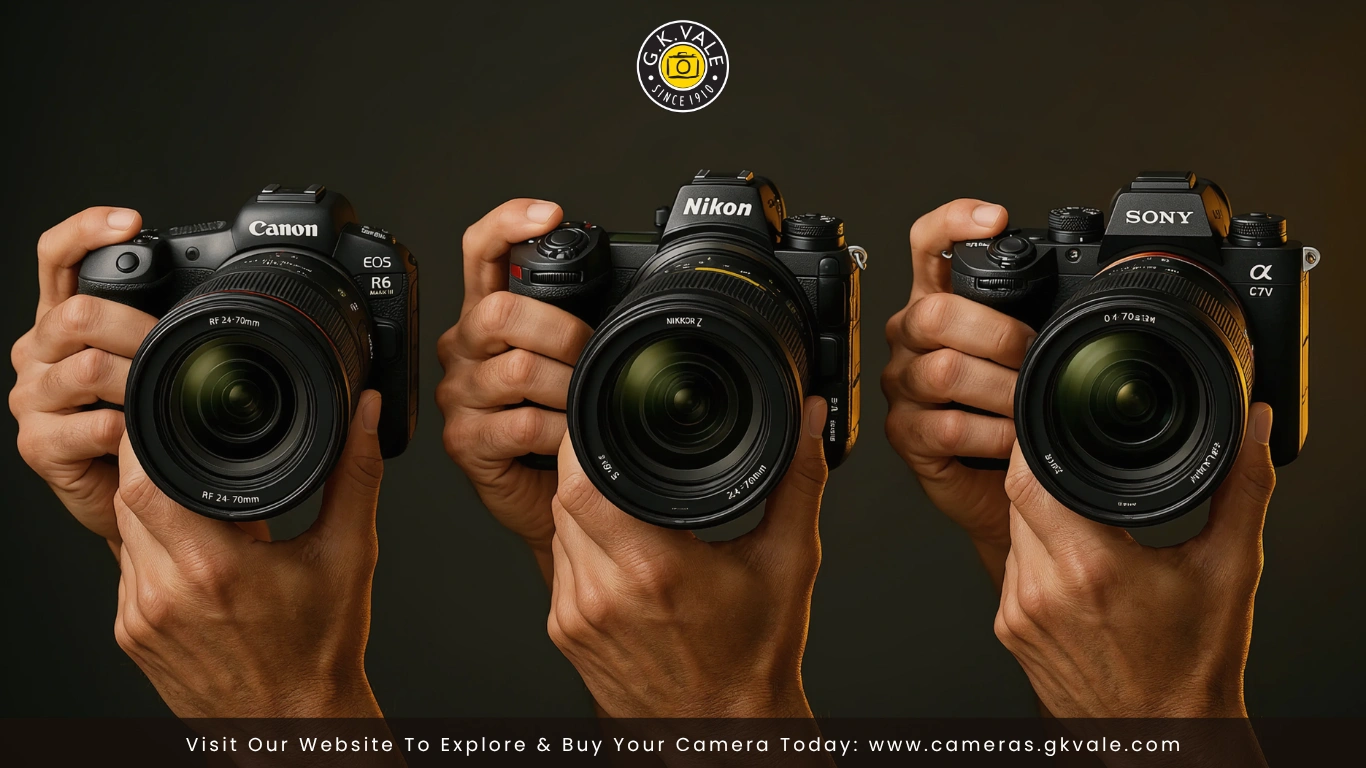
Canon vs Nikon vs Sony at a Glance
Canon is the easiest first system, Nikon is the stills photographer's choice, and Sony has the widest lens selection and the strongest creator range. The table below sums up where each brand stands right now.
| Canon | Nikon | Sony | |
|---|---|---|---|
| Mirrorless mount | RF (full frame) / RF-S (APS-C) | Z (full frame) / Z DX (APS-C) | E (full frame and APS-C) |
| Best for | First-time buyers, family and events, hybrid shooters | Stills, landscapes, wildlife, people who like physical controls | Video, vlogging, anyone who wants the most lens options |
| Third-party autofocus lenses | Licensed for APS-C only (Sigma, Tamron) | Tamron, Viltrox, Laowa, Cosina; Sigma APS-C only | The widest choice: Sigma, Tamron, Viltrox and others |
| Popular entry body | EOS R50, EOS R100 | Z50 II | ZV-E10 II |
| Popular mid-range body | EOS R6 Mark III | Z6 III | Alpha 7 V |
| Video standout | 7K open-gate RAW on the R6 Mark III | RED R3D recording on the Nikon ZR | Creator-first bodies such as the ZV-E10 II |
| Watch out for | Full-frame lenses cost more, with few alternatives | Thinner APS-C lens range | Compact bodies can feel small with big lenses |
Lens licensing and model line-ups as of November 2026. Third-party support changes, so check that a specific lens is officially supported before you buy.
Why the Lens Mount Matters More Than the Camera
A lens mount is the physical and electronic connection between a camera body and its lenses. Canon uses RF, Nikon uses Z and Sony uses E. Lenses built for one mount won't autofocus properly on another without an adapter, and adapters bring trade-offs.
This is why the brand decision sticks. Bodies get replaced every few years, but good lenses stay much longer. Once you own a body and two or three lenses, switching brands means selling all of it at used prices and buying again at new prices. Our camera buying guide explains why glass is the better long-term investment.
Two things make the decision easier. First, all three brands use one mount across APS-C and full frame, so you can start with a smaller APS-C body and move up later without leaving the system. Second, if you already own older DSLR lenses, staying with that brand is usually the cheapest path. Canon EF lenses adapt to RF bodies with Canon's EF-EOS R adapter, and Nikon F-mount lenses adapt to Z bodies with the FTZ II. Our Canon RF vs EF mount guide covers how that works in practice.
Canon: The Easiest Place to Start
Canon is the safest first camera system for most buyers. It has simple menus, dependable Dual Pixel autofocus and the largest base of used gear and accessories. Its main weakness is a narrow choice of third-party full-frame lenses.
In a February 2026 announcement, Canon said it has held the No. 1 share of the global interchangeable-lens camera market for 23 years in a row, from 2003 to 2025, based on its own survey. For a buyer, that scale shows up in practical ways: more used bodies and lenses, more accessories and more people around you who can lend a battery or explain a menu.
The EOS R50 is built around guided menus and dependable autofocus. In the mid-range, the EOS R6 Mark III is the hybrid to beat. It has a 32.5MP full-frame sensor, bursts of up to 40 frames per second with the electronic shutter, and 7K open-gate RAW video. Its 4K at 120fps uses the full sensor width, so it doesn't crop.
The catch most comparisons skip: Canon opened the RF mount to Sigma and Tamron in April 2024, but only for APS-C lenses (see Sigma's RF-mount lens range). As of late 2026 there's still no licensed full-frame autofocus lens from a third party for RF. Go full-frame Canon and expect to buy mostly Canon lenses at Canon prices. Cheaper options such as the RF 28-70mm f/2.8 IS STM help, but the choice is still narrower than on Sony.
- Choose Canon if: it's your first camera, you shoot family, events or travel, or you want strong photo and video in one body.
- Think twice if: you plan to build a big full-frame lens kit on a tight budget.
You can explore Canon cameras online before you visit.
Nikon: The Photographer's Camera, Now Serious About Video
Nikon suits photographers who shoot mostly stills and care about handling. Its bodies have deep grips and logical controls. Since buying RED in 2024, Nikon has also become a serious video brand.
The Z50 II brings that handling to the entry level. It uses the same EXPEED 7 processor as Nikon's flagship Z8 and Z9, so it gets their subject-detection autofocus. It also records 4K at up to 60fps from its 20.9MP APS-C sensor. In the mid-range, the Z6 III uses a 24MP partially stacked full-frame sensor.
Video used to be Nikon's weak spot. That changed when Nikon completed its acquisition of RED, the cinema camera maker, in April 2024. The first camera from that deal is the Nikon ZR. It can record RED's R3D format, Nikon's N-RAW or ProRes RAW internally, at up to 6K 60p.
Nikon's lens picture is better than its reputation suggests. Nikon has licensed the Z mount to Tamron, Viltrox, Laowa and Cosina, so budget primes and zooms do exist. Sigma, though, still only makes APS-C lenses for Z. Nikon is also in a patent dispute with Viltrox, and some third-party Z lenses were pulled from sale in China in March 2026, as Fstoppers reported. Check that a lens is officially supported before you buy it.
- Choose Nikon if: you mostly shoot stills, care about how a camera feels after a long day, or already own Nikon F lenses.
- Think twice if: you want a big choice of small APS-C lenses. The Z DX range is thinner than its full-frame range.
See the Nikon Z range to compare bodies.
Sony: The Most Lens Choice and the Strongest Creator Range
Sony's biggest advantage is openness. Third-party makers can build autofocus lenses for the E-mount, so Sony has the largest catalogue of independent lenses. That brings prices down and fills almost every focal length and budget.
Sigma, Tamron, Viltrox and others all make E-mount glass. For creators, the ZV-E10 II is a dedicated vlogging camera. It has a 26MP APS-C sensor, a directional mic and a flip-out screen made for filming yourself. It has no viewfinder, which makes it a weaker pick if you mostly shoot stills in bright sunlight.
In the mid-range, the Alpha 7 V has a 33MP partially stacked sensor, 30fps blackout-free bursts and pre-capture, which records frames from just before you fully press the shutter.
Sony's trade-offs are small but real. The Alpha 7 V doesn't offer open-gate or RAW video internally, and its 4K at 120fps crops the frame by 1.5x. Compact bodies are great for travel, but some people find the grip cramped with long, heavy lenses.
- Choose Sony if: video is a priority, you want the widest lens choice, or you like a small, light kit.
- Think twice if: you have large hands and plan to use big telephoto lenses. Try the grip first.
Browse Sony Alpha cameras to see what's in stock.
Sony vs Canon vs Nikon: What Actually Separates Them?
Short answer: autofocus and image quality are now close across Canon, Nikon and Sony. The real differences are video features, the price and choice of lenses, and how each camera feels in the hand.
Autofocus
All three track eyes, faces, animals and vehicles. At entry and mid-range prices, autofocus rarely decides the winner, so choose on handling and lenses instead.
Image quality
Sensors of the same size from these brands produce very similar results. Resolution varies a little at the entry level: 20.9MP on the Z50 II, 24.2MP on the R50 and 26MP on the ZV-E10 II. That only matters if you crop hard or print large.
Video
This is where the brands differ most. Canon puts RAW and open-gate video into mid-range bodies. Nikon now has RED technology. Sony has the broadest set of creator-focused cameras. If video drives your purchase, compare the exact models you're considering, not the brands.
Total system cost
This is the difference most buyers miss. Sony is usually the cheapest to grow, because third-party lenses compete on price. Full-frame Canon is usually the most expensive. Nikon sits in between. Before you buy any body, price the two lenses you'll want next.
Handling
No spec sheet tells you how a camera feels. Hold all three, scroll through the menus and press the buttons you'd actually use.
Which Camera Brand Is Best for You?
Short answer: the best camera brand is the one whose lenses fit how you shoot. Beginners usually do best with Canon or Nikon, vloggers with Sony, and photographers who already own Canon EF or Nikon F lenses with the brand they have. Match your main use to the table below, then hold the suggested bodies before you decide.
| If you are… | Lean towards | Why |
|---|---|---|
| A first-time buyer shooting family, travel and food | Canon EOS R50 or Nikon Z50 II | Simple to learn, a viewfinder, and room to grow in the system |
| A vlogger or YouTuber | Sony ZV-E10 II | Built for filming yourself, with a huge choice of lenses |
| A hybrid shooter doing paid photo and video work | Canon EOS R6 Mark III or Sony Alpha 7 V | Strong all-rounders. Canon leads on RAW video, Sony on lens choice |
| A wildlife or sports beginner on a budget | Sony or Nikon | More third-party telephoto zooms than full-frame Canon |
| Already owning Canon EF or Nikon F lenses | Stay with that brand | Official adapters keep your lenses working |
| Still not sure | Rent first | A weekend of real shooting teaches more than any review |
Want specific models matched to a budget? Our best camera for beginners in India guide maps them out. If you're still deciding between formats, start with the DSLR vs mirrorless comparison.
Five Mistakes When Choosing a Camera Brand
- Assuming any lens fits any brand. Third-party support is different on each mount, especially Canon RF full frame.
- Pricing the body and not the lenses. The lenses you'll add over three years usually cost more than the body.
- Choosing for a flagship spec you'll never use. 7K RAW or 30fps sounds great, but only matters if your work needs it.
- Ignoring the lenses you already own. An adapter and an old EF or F lens can save you a lot of money.
- Picking a brand because your favourite creator uses it. Their hands, subjects and budget aren't yours.
Try Canon, Nikon and Sony Side by Side in Bangalore
The quickest way to settle the Canon vs Nikon vs Sony question is to hold all three, side by side, with the lenses you'd actually buy. We've been part of Bangalore photography at GK Vale since 1910, and the most useful thing we can do is put three bodies on the counter and let your hands decide.
If you'd rather test on a real shoot first, rent a camera before you buy and decide based on experience rather than spec sheets. Looking beyond the big three? Browse our other brands.
Conclusion: Pick the System, Then the Camera
There's no single best camera brand, only the right system for how you shoot. Canon is the safest first step and a strong hybrid choice. Nikon is the best fit if stills and handling come first. Sony wins on lens choice and video.
Decide which lenses you'll need over the next three years, then pick the brand that sells them at a price you can live with. For more on gear and buying decisions, our Gear Insider guides go deeper.
Sources: Canon India, Nikon Corporation, Sigma, PetaPixel and Fstoppers. Specifications come from manufacturer announcements and the reviews linked above. Check current firmware and lens support before you buy.
Still torn between Canon, Nikon and Sony?
Tell us what you shoot and your budget, and we'll help you compare.
Frequently Asked Questions
Is Canon or Nikon better for beginners?
Both are excellent. Canon's EOS R50 is slightly easier to learn, with guided menus and dependable autofocus. Nikon's Z50 II has deeper grips, more physical controls and flagship-level subject detection, so it grows with you if you want to learn manual shooting. Pick the one that feels better in your hands.
Which camera brand has the most lenses?
Sony E-mount has the largest overall choice, because Sony lets third-party makers such as Sigma, Tamron and Viltrox build autofocus lenses for it. Nikon Z is open to several third parties. As of late 2026, Canon RF still has no licensed third-party autofocus lenses for full frame.
Is Sony better than Canon for video?
It depends on the model. Sony has the broadest range of creator cameras, like the ZV-E10 II. Canon's EOS R6 Mark III offers internal 7K open-gate RAW, which the Sony Alpha 7 V doesn't. For vlogging, Sony usually leads. For RAW hybrid work, Canon's mid-range is the stronger pick.
Is Nikon still a good camera brand in 2026?
Yes. Nikon's Z system is mature, and its handling is still widely praised. Its 2024 purchase of RED, the cinema camera company, has strengthened its video side: the Nikon ZR records RED's R3D format internally. Its main weakness is a thinner range of APS-C lenses.
Can I use Canon lenses on a Sony or Nikon camera?
You can, with third-party adapters, but autofocus speed and feature support vary from lens to lens. It works for some uses but isn't a reliable long-term plan. If you own many lenses from one brand, staying with that brand is usually cheaper and simpler.
Should I buy APS-C or full frame for my first camera?
For most first-time buyers, APS-C is the smarter start. The bodies and lenses are smaller and cheaper, and Canon, Nikon and Sony all let you move up to full frame on the same mount later. Full frame is worth it for low-light work, shallow depth of field or paid shoots.