
Best Camera for Beginners in India: 2026 Guide
The best camera for beginners in India in 2026 is the Canon EOS R50 for most people, because it focuses reliably on its own, has a flip-out touchscreen and costs around ₹67,000 with a kit lens. On a budget under ₹50,000, pick the Canon EOS R100 instead. However, if video matters more than photos, the Sony ZV-E10 II is worth the extra money.
Choosing the best camera for beginners starts with one honest question: what can’t your phone do? Your phone takes great photos, right up until the light drops, your kid starts running, or you want a properly blurred background without “portrait mode” chewing the edges off someone’s ears. That’s exactly when a real camera starts earning its place in your bag.
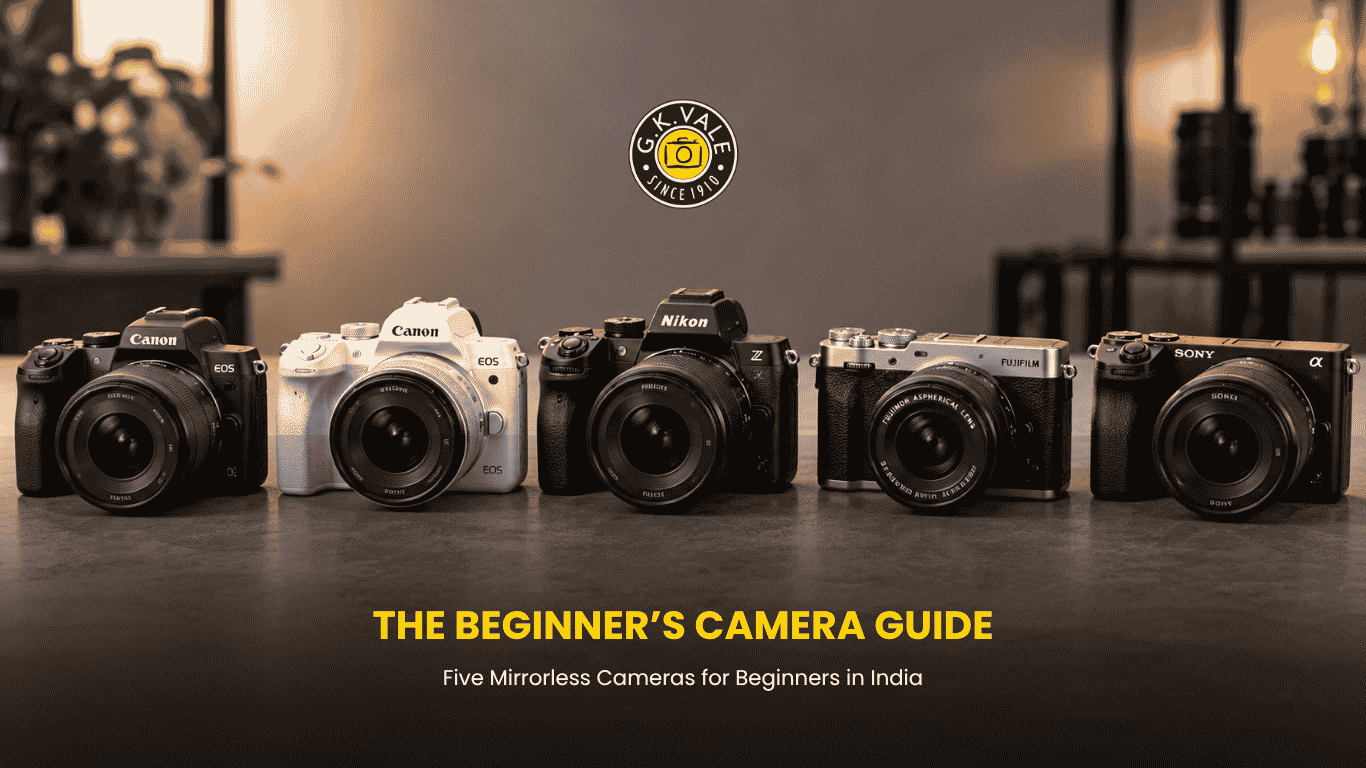
So we skipped the spec-sheet drama. Instead, we picked five cameras, sorted them by budget and by what you actually shoot, and flagged what each one quietly gets wrong. All prices are Indian street prices as of September 2026.
Still deciding what type of camera you need? Then start with our camera buying guide first, since this page is the next step: actual models, actual rupees.
Key takeaways
- Top pick overall: Canon EOS R50, around ₹67,000 with the 18–45 mm kit lens.
- Under ₹50,000: Canon EOS R100, usually ₹47,000–₹51,000 with kit lens.
- For video: Sony ZV-E10 II. To grow into: Nikon Z50 II. For no-edit travel photos: Fujifilm X-M5.
- Mirrorless beats DSLR for almost every beginner in 2026.
- Keep ₹8,000–₹15,000 extra for a card, spare battery and bag, and plan a 50 mm f/1.8 prime as your first upgrade.
- Hold it before you buy, and always insist on an India warranty and a GST invoice.
Best Camera for Beginners in India: Quick Comparison
| Camera | Best for | Price with kit lens (approx.) | Why it made the list |
|---|---|---|---|
| Canon EOS R100 | Tight budgets, photos first | ₹47,000–₹51,000 | Cheapest route into a modern lens system |
| Canon EOS R50 | Most beginners | ₹66,000–₹68,000 | Easiest all-rounder, flip screen, clean 4K |
| Nikon Z50 II | Learning photography seriously | ₹85,000–₹92,000 | Proper grip, viewfinder, smart autofocus |
| Fujifilm X-M5 | Travel, street, people who hate editing | ~₹88,000 | Film looks straight out of the camera |
| Sony ZV-E10 II | YouTube, reels, vlogging | ₹92,000–₹97,000 | Built for video first, photos second |
Prices are indicative street prices in India (September 2026) with the standard kit lens. Because they move with festive offers and stock, confirm the price before you buy.
You’ll notice all five are APS-C mirrorless cameras. That’s no accident, since the best camera for beginners in 2026 is almost always an APS-C mirrorless body. Also, APS-C gives you a sensor far bigger than your phone’s in a body that still fits a small sling bag, at a price that leaves room for a second lens.
What Makes the Best Camera for Beginners?
The best camera for beginners is forgiving, not dumbed down. In other words, it should find and track faces and eyes on its own, show you the exposure before you press the shutter, have menus you can learn in a weekend, and sit on a lens system you’ll still want five years from now.
What actually matters when you’re starting out
- Autofocus with eye detection. This decides how many of your photos come out sharp, so it matters more than any other spec for a new shooter.
- A screen that flips or tilts. Low angles, high angles, selfies and videos of yourself all get harder when the screen is fixed.
- Size and weight. The camera you carry beats the camera at home. Around 500 g with the kit lens is easy to carry all day.
- The lens system. You’re not just buying a camera; you’re joining a club. Therefore, check that affordable lenses exist for the mount.
- Total kit cost. Cards, a spare battery, a bag and eventually a second lens all add up, as the costs section below shows.
Meanwhile, some specs matter far less than the box suggests: megapixels above 20, 8K video, and burst speeds of 30 frames a second. They’re nice for bragging, but they’re rarely the reason a beginner’s photo didn’t work.
Mirrorless or DSLR: Which Is the Best Camera for Beginners?
Mirrorless is the better first camera for almost every beginner in 2026. It previews your exposure live, focuses more reliably and handles video properly. Besides, it’s where Canon, Nikon, Sony and Fujifilm are putting all their new cameras and lenses.
There is one exception, though: a very tight budget. If you have ₹30,000–₹35,000 and only care about photos, a good used DSLR with a 50mm lens still teaches manual photography beautifully. Just remember you’re buying into a system that has stopped growing. For the full trade-off, read our DSLR vs mirrorless camera comparison.
Best Camera for Beginners, Reviewed: Our 5 Picks
Each review below covers what the camera does well, where it cuts corners, what it costs in India, and exactly who should and shouldn’t buy it.
Canon EOS R100: Best Camera for Beginners Under ₹50,000
Canon’s EOS R100 is the lowest-cost way into the company’s current RF mirrorless system. You get a 24.1 MP APS-C sensor and Canon’s Dual Pixel autofocus, which is quick and dependable for everyday photos, all in a very light body.
Naturally, the savings show up in the details. Its rear screen is fixed and isn’t a touchscreen, while 4K video is cropped and limited to 24p. There’s also no advanced subject tracking like on newer models. For someone learning photography on weekends, none of that is a dealbreaker. For vloggers, however, it is.
Although the kit carries an MRP of ₹64,995, it usually sells for ₹47,000–₹51,000. That makes it the best camera for beginners who need to stay under ₹50,000.
- Choose this if: you want a real camera under ₹50,000, you mostly shoot photos, and you want room to add RF lenses later.
- Skip this if: you plan to film yourself or shoot a lot of video, because the fixed screen will annoy you within a week.
Canon EOS R50: Best Camera for Beginners Overall
If a friend asked us for the best camera for beginners with no other context, this would be the one. The Canon EOS R50 pairs a 24.2 MP APS-C sensor with Dual Pixel CMOS AF II, which detects people, animals and vehicles and then follows them around the frame. Put simply: you point, it finds the eye, and you get the shot.
On top of that, it weighs about 375 g, has a fully articulating touchscreen, and records clean 4K 30p video without a crop. Canon’s guided menus also explain settings in plain language, which quietly shortens the learning curve.
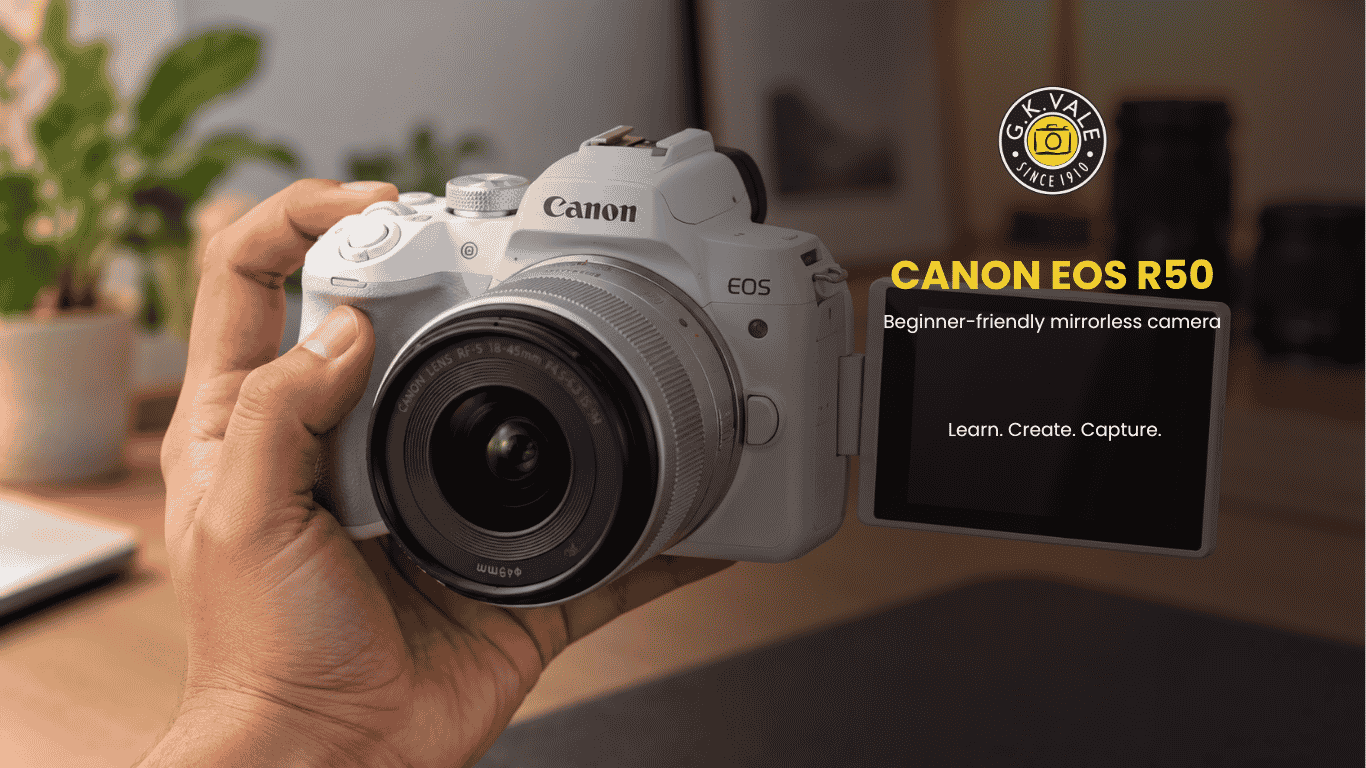
In terms of price, expect around ₹66,000–₹68,000 with the 18–45 mm kit lens (MRP ₹75,995). Alternatively, a twin-lens kit with the 55–210 mm zoom sells for roughly ₹87,000–₹89,000.
- Choose this if: you want one camera for family, travel, reels and learning manual settings, without wrestling menus.
- Skip this if: you shoot all day away from a charger, since the small LP-E17 battery means you’ll want a spare.
Nikon Z50 II: Best for Beginners Who Want to Grow Fast
This is the camera you won’t outgrow in a year. Nikon gave the Z50 II a deep, comfortable grip, a proper electronic viewfinder, a vari-angle screen, and a 20.9 MP APS-C sensor driven by its EXPEED 7 processor, the same processor family used in its professional bodies. Its autofocus also recognises nine subject types, including people, animals and birds.
Twenty-one megapixels may sound lower than its rivals. In practice, though, you won’t see the difference in anything short of a huge print or an aggressive crop.
Nikon India lists the Z50 II with the 16–50 mm lens at ₹98,945, while street prices typically land between ₹85,000 and ₹92,000.
- Choose this if: you’re serious about learning photography, you like a viewfinder, or you have wildlife and birding ambitions.
- Skip this if: every rupee counts or you want the lightest kit, because the Canon R50 covers most of this for noticeably less.
Fujifilm X-M5: Best for Travel and People Who Hate Editing
At 355 g, the Fujifilm X-M5 is the smallest and lightest camera in Fujifilm’s X-series. It uses a 26.1 MP X-Trans CMOS 4 sensor and has a dedicated dial for Fujifilm’s film simulations, which are colour and tone profiles that make JPEGs look finished the moment you take them.
That dial is the real selling point. After all, plenty of beginners buy a camera, shoot 2,000 photos, and never edit a single one. The X-M5 is built for exactly that person, so your holiday shots come out looking graded without opening Lightroom.
There’s no viewfinder, however, so in harsh afternoon sunlight you’ll be squinting at the screen. Currently the body alone sells for about ₹78,000, and the 15–45 mm kit for about ₹88,000.
- Choose this if: you travel a lot, love a retro look, and want good-looking photos with zero editing.
- Skip this if: you want a viewfinder or a big, chunky grip.
Sony ZV-E10 II: Best Camera for Beginners Who Shoot Video
Think of the Sony ZV-E10 II as a video camera that also takes photos, not the other way round. It has a 26 MP APS-C sensor, records 4K up to 60p, uses a much larger battery than its predecessor, and has a flip-out screen made for filming yourself. Sony’s Product Showcase mode even shifts focus from your face to the product you’re holding, which is exactly what unboxing and review creators need.
Unsurprisingly, the compromise is on the stills side, since there’s no viewfinder and the controls are minimal. It’s also the most expensive camera here once you add the lens: Sony India lists the kit at ₹1,09,990, with street prices around ₹92,000–₹97,000.
- Choose this if: YouTube, reels or vlogs are the main reason you’re buying a camera.
- Skip this if: you mainly want to learn photography, because you’d be paying for video features you don’t use.
Which Beginner Camera Fits What You Shoot?
Start with your main subject, not the spec sheet. After all, the same camera can be perfect for a travel photographer and frustrating for a new YouTuber.
| If you mostly shoot | Pick | Why |
|---|---|---|
| Kids, pets, family events | Canon EOS R50 | Eye-tracking autofocus and an easy flip screen |
| Travel and street | Fujifilm X-M5 or Canon EOS R50 | Small, light, great colour straight out of camera |
| YouTube, reels, vlogs | Sony ZV-E10 II | 4K 60p, big battery, creator-focused features |
| Birds and wildlife (think Hebbal or Ranganathittu) | Nikon Z50 II or Canon R50 twin-lens kit | Subject detection plus a telephoto option from day one |
| Learning manual photography properly | Nikon Z50 II | Viewfinder, grip and direct controls |
| Photos only, strict budget | Canon EOS R100 | Real sensor, real lens system, lowest price |
Best Camera for Beginners by Budget in India
Your budget, your camera
- Under ₹50,000: the Canon EOS R100 kit is the best camera for beginners at this price. Nothing else new here gives you a modern lens mount and this image quality.
- ₹50,000–₹75,000: go for the Canon EOS R50. This is the sweet spot for first-time buyers, so spend what’s left on a fast memory card and a spare battery.
- ₹75,000–₹1,00,000: pick the Nikon Z50 II for photography, the Sony ZV-E10 II for video, or the Fujifilm X-M5 for style and travel.
- Above ₹1,00,000: either you’re not really a beginner anymore, or you’re about to overbuy. Instead, put that money into a mid-range body and a good prime lens.
What Your First Camera Really Costs
Budget an extra ₹8,000–₹15,000 on top of the camera price. A beginner kit needs a fast SD card, a spare battery, a padded bag and a cleaning cloth. Otherwise, your first long shoot ends early, usually at the worst possible moment.
Then there’s the lens. Kit zooms are fine in daylight but struggle indoors after sunset, so the cheapest dramatic upgrade is a 50 mm f/1.8 prime. For example, Canon’s RF 50mm f/1.8 STM retails around ₹21,000, and it’ll change your low-light and portrait photos more than any new camera body would.
Most beginners overlook this: the lens mount you pick today decides what you can buy for the next decade. So before choosing between Canon, Nikon, Sony or Fujifilm, look at the affordable primes available for that mount, not just the camera.
5 Mistakes First-Time Camera Buyers Make
- Buying for the photographer you might be in 2030. The best camera for beginners is the one that fits what you’ll shoot this year, because you can always add lenses later.
- Picking on megapixels. 24 MP is plenty for large prints and heavy crops, whereas autofocus and lenses matter far more.
- Ignoring the viewfinder question. In bright Indian sunlight, rear screens wash out. Therefore, if you shoot outdoors at midday, a viewfinder is worth having.
- Chasing the lowest online price. Grey-market cameras can come without an India warranty, so always ask for a GST invoice with the serial number on it.
- Buying without holding it. Ten minutes with the camera in your hands settles questions no review can.
Should You Rent a Camera Before You Buy?
Renting first makes sense when you’re torn between two cameras or unsure how much you’ll actually shoot. A weekend with a body on a real outing, a trip or a family function tells you more about grip, battery life and autofocus than any comparison table.
On the other hand, if you already know what you want and plan to shoot every week, simply buy it. Ownership gets you warranty cover and no daily fee. But if you’re still comparing, rent camera gear in Bangalore and decide with real photos in hand.
Buying Your First Camera in Bangalore
The easiest way to settle “R50 or Z50 II?” is to pick them both up. At GK Vale’s stores in MG Road, Indiranagar, Jayanagar and Gandhinagar, you can handle cameras side by side, try the menus, and ask someone who shoots with them every week. Because we’re an authorised dealer for Canon, Nikon and Sony, every camera comes with an India warranty and a GST invoice.
Want to look first? Browse the Canon range, Nikon cameras and lenses, or the Sony Alpha lineup online. For Fujifilm, see other brands we stock.
So, Which Is the Best Camera for Beginners for You?
For most people, the Canon EOS R50 is the best camera for beginners in India: easy to learn, sharp, light and fairly priced. Otherwise, go for the Canon EOS R100 if your budget stops at ₹50,000, the Nikon Z50 II if you want to grow into serious photography, the Fujifilm X-M5 if you want gorgeous photos without editing, and the Sony ZV-E10 II if video comes first.
Whichever you choose, keep ₹10,000 or so aside for a card, battery and bag, and plan your first prime lens early. Any of these five will outperform your skills for a good few years, which is exactly what you want.
Still stuck between two?
Bring your budget and tell us what you shoot. Then hold both cameras before you commit.
Four stores across Bangalore
Mon–Sat, 9:30 AM – 8:30 PM
Best Camera for Beginners: Frequently Asked Questions
Which is the best camera for beginners in India under ₹50,000?
The Canon EOS R100 is the best camera for beginners under ₹50,000. It usually sells for ₹47,000–₹51,000 with the RF-S 18–45 mm kit lens and gives you a 24.1 MP APS-C sensor plus access to Canon’s RF lens system. However, its screen is fixed and 4K video is cropped, so it suits photography far better than vlogging.
Canon, Nikon or Sony: which brand is best for beginners?
All three make excellent beginner cameras, so pick the camera rather than the logo. Canon’s EOS R50 and R100 are the easiest to learn and most affordable. Meanwhile, Nikon’s Z50 II has the best handling and viewfinder for its price, and Sony’s ZV-E10 II leads for video. Finally, compare how each feels in your hand and which affordable lenses exist for its mount.
Is Canon EOS R50 or R100 better for a beginner?
The Canon EOS R50 is better if you can afford roughly ₹18,000 more, because it adds a fully articulating touchscreen, smarter subject-tracking autofocus and uncropped 4K 30p video. The Canon EOS R100 makes sense only when your budget is firmly under ₹50,000 and you mainly shoot photos. Also, both use the same RF lens mount, so lenses carry over.
Is a smartphone enough, or should a beginner buy a camera?
A recent flagship phone is enough for daylight snaps and social posts. However, a dedicated camera pulls ahead in low light, with moving subjects like kids and pets, for natural background blur, and whenever you need zoom without losing detail. So if those situations frustrate you, an APS-C mirrorless camera is a real, visible upgrade.
What is the best starter camera for YouTube in India?
The Sony ZV-E10 II is the best starter camera for YouTube in this guide. It records 4K up to 60p, has a flip-out screen for framing yourself, a large battery and a Product Showcase mode for review videos. On a smaller budget, though, the Canon EOS R50 also works well for talking-head videos and reels.
Should a beginner buy a used camera?
A used camera can be a smart buy, provided you check it carefully. First, ask for the shutter count, inspect the sensor for scratches, test every button and confirm the battery holds charge. Then prefer sellers who provide the original invoice. Still, for a first camera, a new body with an India warranty removes most of the risk for a modest extra cost.
Is the twin-lens kit worth buying for a beginner?
The twin-lens kit is worth it if you shoot sport, wildlife or birds, since the extra telephoto zoom, such as Canon’s 55–210 mm, costs noticeably less in a bundle than bought separately. If you mostly shoot people, travel and food, however, skip it and spend the difference on a 50 mm f/1.8 prime instead.