
Camera Buying Guide: How to Choose the Right Camera
This camera buying guide comes down to four things: what you actually shoot, how much gear you're willing to carry, your total budget including at least one extra lens, and the lens system you're prepared to commit to. Everything else, megapixels included, matters less until those four decisions are clear.
Buying a camera should take an afternoon. Instead, it can turn into three weeks, forty YouTube videos, and a forum thread that ends with someone arguing about full-frame. This camera buying guide cuts through that noise. We'll walk through each decision in the order that actually matters, with real pricing context for India, honest trade-offs, and a practical checklist you can use before you buy. No spec-sheet flexing.
How to Choose a Camera: The Six-Step Short Version
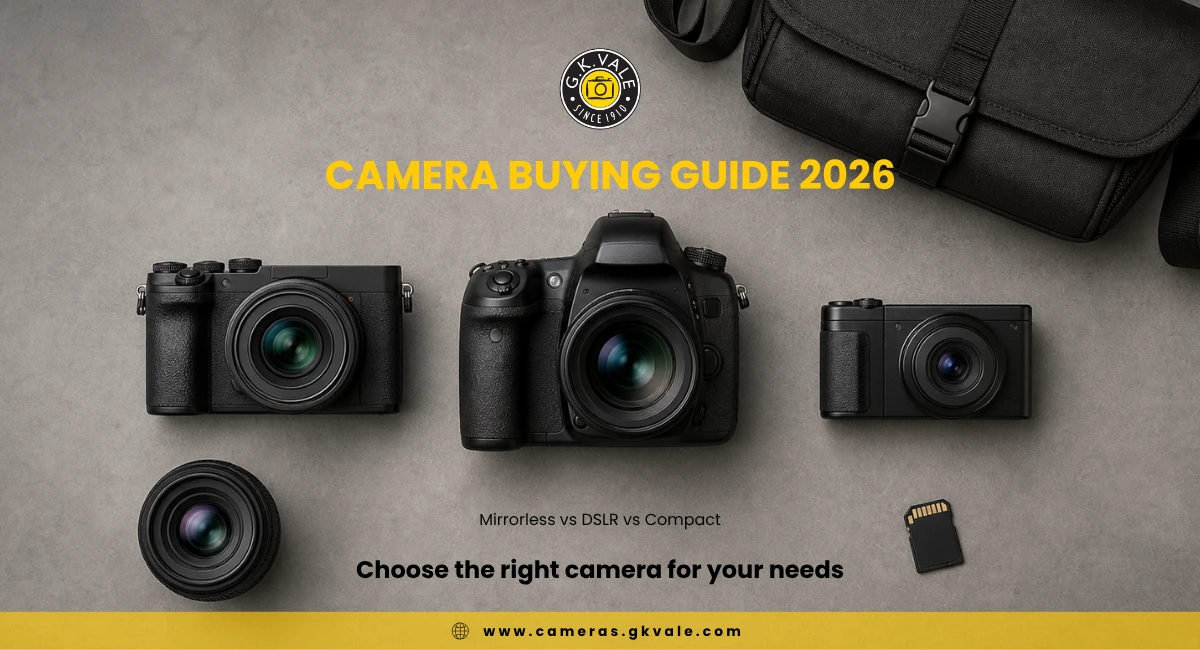
To choose a camera, work in this order: define your main subject, pick a camera type, choose a sensor size, set a total budget with a 70/30 body-to-extras split, commit to a lens mount, then hold the body in your hands before buying. Deciding in this sequence prevents the most common outcome — an expensive body paired with one mediocre kit lens for two years.
- Name your subject. Kids, travel, weddings, food, wildlife, YouTube — pick one primary.
- Pick a type. Mirrorless suits most new buyers. Compact for pocketability. Action cam for movement.
- Choose a sensor. APS-C is the value sweet spot. Full-frame is a want, not a need.
- Budget the whole kit. Body, lens, card, bag, spare battery.
- Commit to a mount. You're buying into a lens ecosystem for the next eight to ten years.
- Hold it. Ergonomics decide whether the camera leaves your house or lives in a cupboard.
Start With What You Shoot, Not What You Buy
The biggest predictor of camera satisfaction is whether the camera matches the subject. A body that's brilliant for landscapes can be genuinely frustrating at a toddler's birthday party, because the two demand opposite things. One wants dynamic range and weather sealing. The other wants fast, sticky autofocus and clean high-ISO files.
So work backwards from your subject, not forwards from a shortlist.
| What you shoot | Prioritise | Don't overpay for |
|---|---|---|
| Family, kids, pets | Eye-detect autofocus, low-light performance | Megapixels, weather sealing |
| Travel & street | Small body, compact lenses, USB-C charging | Big zooms, high burst rates |
| YouTube & reels | Flip-out screen, mic input, reliable video autofocus | Very high-resolution stills |
| Weddings & events | Dual card slots, fast primes, battery life | In-camera filters and effects |
| Wildlife & sport | Burst speed, subject tracking, telephoto options | Full-frame — APS-C reach helps you here |
| Landscapes | Dynamic range, weather sealing, tripod-friendly build | Autofocus speed |
Write down your top two subjects right now. If they conflict — say wildlife and street — buy for the one you'll shoot more than 70% of the time. Trying to buy one camera that's perfect for both is how people end up with something that's mediocre at each.
Which Type of Camera Should You Buy?
Mirrorless is the sensible default for most new buyers in 2026. Industry shipment data from CIPA shows mirrorless accounted for roughly 90% of all interchangeable-lens cameras shipped in 2025, while DSLR shipments fell below 700,000 units globally. DSLRs still take excellent photographs — but new body and lens development has largely stopped, so you're buying into a system that won't grow.
Compacts, meanwhile, are the genuine surprise of the current market. CIPA's 2026 figures show fixed-lens compact shipments growing around 30% year on year, almost exactly matching the rate at which DSLRs declined. Pocketability and "it isn't my phone" appeal are driving it.
| Type | Indicative India price | Strength | Real limitation |
|---|---|---|---|
| Entry mirrorless | ₹55,000 – ₹80,000 with kit lens | Best all-round balance, growing lens range | The bundled kit lens is the weak link |
| Used DSLR | ₹20,000 – ₹45,000 | Cheapest genuine route to manual controls | Closing system, weaker video |
| Premium compact | ₹40,000 – ₹1,20,000 | Actually fits in a pocket | Fixed lens, struggles in low light |
| Full-frame mirrorless | ₹1,50,000+ before lenses | Best low-light and depth-of-field control | Heavy, expensive glass, overkill for most |
| Action camera | ₹25,000 – ₹55,000 | Rugged, stabilised, mountable | Small sensor, wide-angle only |
Prices are indicative ranges for India in 2026 and shift with festive offers, imports and stock. Check live pricing before you fix a budget.
If you're weighing the two formats seriously, our full DSLR vs mirrorless camera comparison breaks the decision down by autofocus, video, battery life, lens cost and shooting genre.
Camera Sensor Sizes Explained
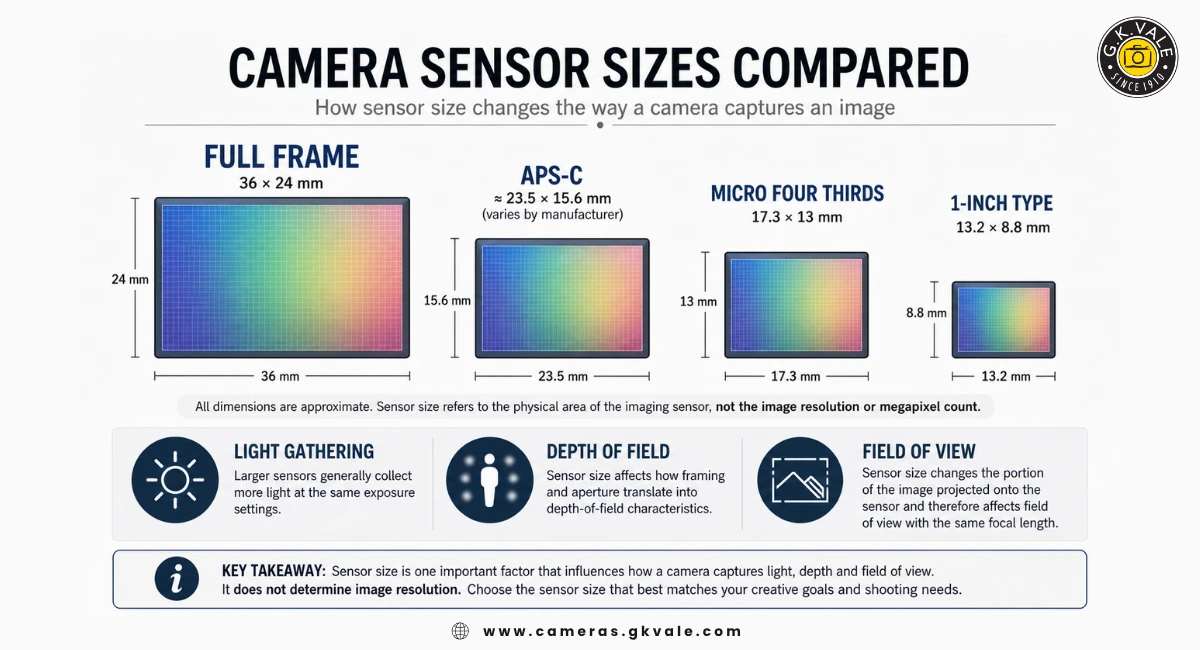
Sensor size affects low-light performance, depth of field and lens size far more than megapixel count does. A 24MP APS-C sensor and a 24MP full-frame sensor produce identically sized images — the full-frame version simply gathers more light per pixel and blurs backgrounds more easily at the same framing.
| Sensor | Crop factor | Best for | Trade-off |
|---|---|---|---|
| Full-frame | 1.0× | Low light, portraits, professional work | Body and lenses cost and weigh the most |
| APS-C | ~1.5× (1.6× on Canon) | The value sweet spot for most buyers | Slightly less low-light headroom |
| Micro Four Thirds | 2.0× | Compact travel kits and video | Smaller lens catalogue than it once had |
| 1-inch | ~2.7× | Premium compacts, vlogging | Struggles indoors and after dark |
The bit most guides skip: on an APS-C sensor, a 300mm lens frames like a 450mm. For wildlife and cricket, the crop factor is an advantage, not a compromise — you get reach that would cost considerably more on full-frame.
Unless you shoot paid portraits or regular low-light events, an APS-C sensor will not be the thing holding your photographs back. Your understanding of ISO, aperture and shutter speed will matter far more in the first year.
How Much Should You Spend on a Camera?
Budget for the full kit, not the body. A workable rule is the 70/30 split — roughly 70% of your spend on the body-and-first-lens combination, with 30% held back for a second lens, a fast memory card, a spare battery and a bag. Buyers who put 100% into the body almost always end up shooting one mediocre kit lens for two years.
There's also a real reason 2026 is a friendlier year to buy in India. Following the GST Council's 2025 revision, effective 22 September 2025, cameras and most photographic goods moved from the 28% slab down to 18% GST. That covers DSLRs, mirrorless bodies, compacts and most accessories under HSN 8525. It's a structural price change, not a seasonal sale.
| Total budget | Realistic kit | Who it suits |
|---|---|---|
| Under ₹40,000 | Good used DSLR or older mirrorless plus a 50mm prime | Learning manual controls on a student budget |
| ₹40,000 – ₹80,000 | Entry APS-C mirrorless kit, card, battery, bag | The majority of first-time buyers |
| ₹80,000 – ₹1,50,000 | Enthusiast APS-C body with one quality prime or f/2.8 zoom | Serious hobbyists and semi-pro creators |
| ₹1,50,000+ | Entry full-frame with two lenses, or a pro APS-C hybrid | Paid work, weddings, commercial video |
Before you commit, add ₹8,000 to ₹15,000 to whatever number you landed on. Cards, batteries, a bag and a decent filter aren't optional extras — they're where first-camera budgets quietly break. If you want specific models mapped to these bands, our best camera for beginners in India guide does exactly that.
Why Lenses Matter More Than Camera Bodies
Lenses outlast camera bodies by a decade or more, which makes glass the more durable investment. CIPA's shipment data reflects this — roughly 1.5 lenses ship for every interchangeable-lens body, and lens sales have held up better than body sales through the current market.
The kit lens bundled with your camera exists to hit a price point. It's perfectly fine outdoors in daylight and struggles nearly everywhere else. The cheapest meaningful upgrade any beginner can make is a fast prime — a 35mm or 50mm f/1.8 — usually for less than a third of what the body cost.
Most first-time buyers overlook this: the lens mount you choose today decides what you can buy for the next decade. Switching systems later means selling everything at a loss. Check the mount's lens roadmap — particularly the affordable native primes and whether third-party makers support it — before you check the body's spec sheet. Our Canon RF vs EF mount guide shows how much a mount decision shapes what follows.
Camera Specs That Matter, and the Ones That Don't
Marketing rewards numbers that print well on a box. In practice, autofocus quality, ergonomics and lens availability affect your results far more than megapixel count or maximum burst rate.
| Spec | Verdict | Why |
|---|---|---|
| Megapixels | Mostly ignore above 20MP | 24MP already prints large and crops hard |
| Autofocus & subject detection | Matters a lot | Decides how many keeper frames you actually get |
| In-body stabilisation | Matters for video and handheld low light | A nice-to-have for daylight stills |
| Burst speed | Matters for sport and wildlife only | Otherwise it just fills your card faster |
| 8K video | Ignore for now | Huge files, heat limits, almost nobody delivers in 8K |
| Battery life & USB-C charging | Badly underrated | Determines whether your shooting day ends early |
| Weather sealing | Matters if you shoot monsoon or outdoors | Rarely present on entry-level bodies |
| Dual card slots | Matters for paid work only | Insurance against card failure mid-event |
Seven Mistakes First-Time Camera Buyers Make
- Buying the body first and treating the lens as an afterthought. The lens does more of the visible work.
- Chasing full-frame too early. Bigger sensor, bigger lenses, bigger bag — and the camera stays home.
- Ignoring ergonomics. If your hand cramps in ten minutes, the spec sheet stops mattering.
- Skipping the lens roadmap. A great body on a thin mount is a trap you'll notice in year three.
- Buying grey-market to save a few thousand rupees. No India warranty, no service centre support, no recourse.
- Forgetting the total cost. Cards, batteries, a bag and storage are real money.
- Buying without handling the camera. Ten minutes in a showroom settles questions no review can.
Buy New or Rent First: Which Route Makes Sense?
If you already know what you need and plan to use it regularly, buying new is the safer long-term choice. If you're still deciding, renting the camera first lets you test the body, lens and features in real shooting conditions before committing your budget. The right route depends on how confident you are about the gear you need and how often you'll use it.
| Route | Best for | Why it makes sense |
|---|---|---|
| Buy new | Regular photographers and long-term use | Warranty coverage, latest features and ownership of the gear |
| Rent first | First-time buyers and photographers comparing options | Test the camera in real shooting conditions before buying |
| Rent for occasional projects | Weddings, travel, wildlife and one-off shoots | Access professional gear without a large upfront investment |
If you're unsure whether a particular camera or lens is right for you, renting it before buying can be a smart step. You can use the gear on an actual shoot, evaluate its autofocus, handling, battery life, low-light performance and lens compatibility, and then make a more confident purchase decision.
For photographers who already know the camera they want and expect to use it regularly, buying new gives you the advantage of warranty coverage and long-term ownership. But if you're still comparing models, renting a camera before you buy can help you choose based on real experience rather than specifications alone.
Buying a Camera in India: Warranty, Grey Market and Where to Buy
Always confirm the camera carries an India warranty from the manufacturer's authorised distributor. Imported grey-market bodies are cheaper because they were never officially brought into the country — which means Indian service centres can decline warranty repairs, and regional support may differ.
Ask for three things before you pay, online or in person:
- A GST invoice carrying your name and the body's serial number
- Confirmation that the warranty is registered for India
- For used gear, whether the sensor and shutter have been checked
There's a practical argument for buying somewhere you can walk back into with this camera buying guide. A sensor clean, a firmware issue or a warranty claim becomes a short trip rather than a two-week courier gamble. We've been selling, servicing and shooting cameras at GK Vale in Bangalore since 1910, and the single most useful thing we do isn't recommending a model — it's handing you three bodies across the counter and letting your hands decide. You can browse the Canon, Nikon and Sony ranges online first, or look through other brands if you're considering something outside the big three.
Your Camera Buying Guide Checklist
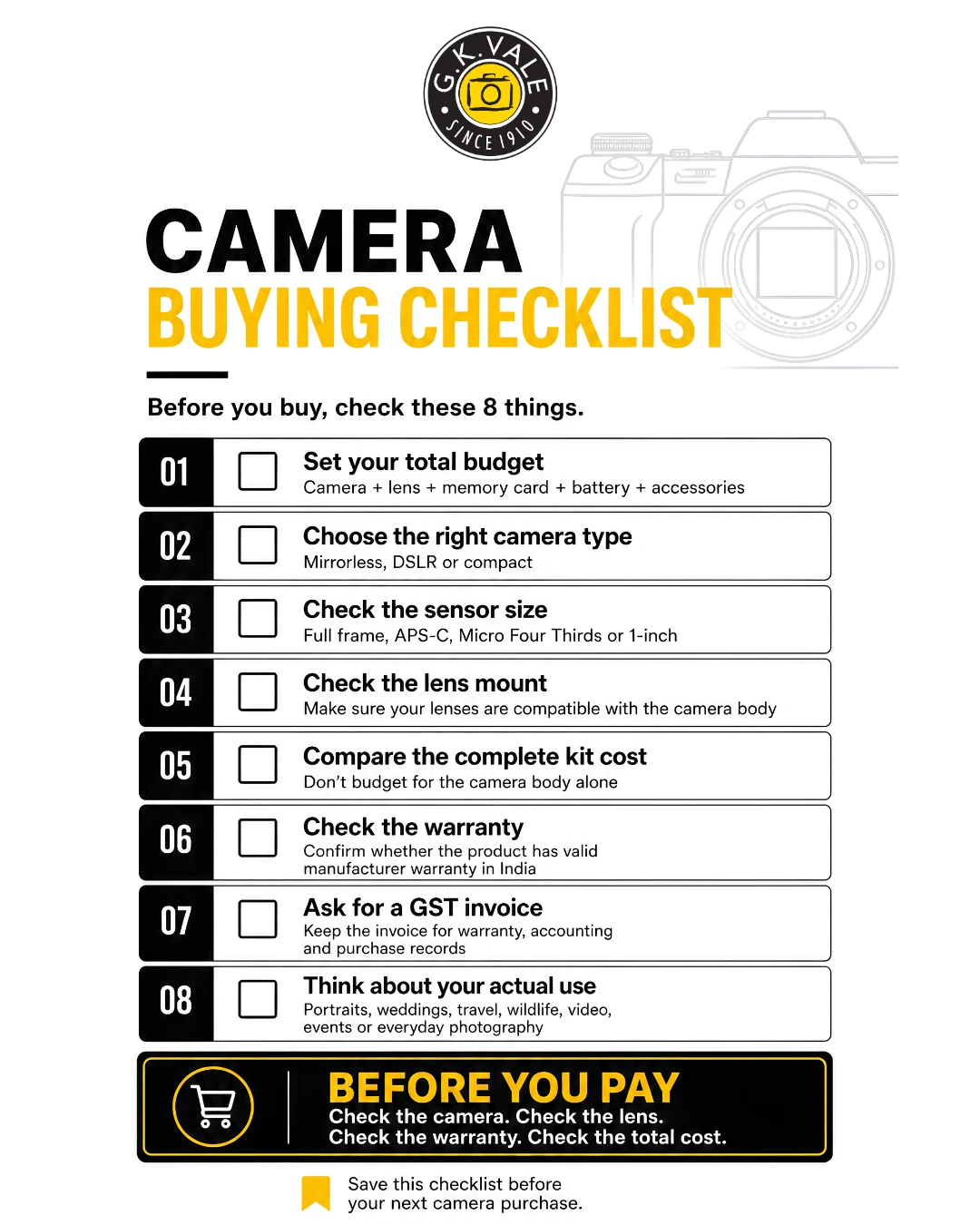
Run through this before you pay:
- I know my primary subject
- I've chosen a camera type and sensor size deliberately, not by default
- I've checked the lens roadmap for this mount
- My budget includes a second lens, card, battery and bag
- I've physically held the camera
- The seller is authorised and provides an India warranty
- I have a GST invoice with the serial number on it
- I've checked the shutter count, if buying used
Conclusion: Choosing the Camera That Fits How You Shoot
Choosing a camera is really choosing a system, a weight you'll carry, and a set of lenses you'll live with for years. Get those three right and almost any modern camera will outperform your current skill level for a long time — which is a genuinely freeing thought when you're stuck between two shortlisted bodies at midnight.
Use this camera buying guide in order: subject first, then type, then sensor, then a budget that leaves room for glass. Ignore megapixel bragging. Take autofocus and ergonomics seriously. And if you're still torn between two options, don't decide from a spec sheet — pick both up and notice which one you don't want to put down. For more on gear, technique and buying decisions, our Gear Insider guides go deeper on each.
Still deciding?
Bring your budget and tell us what you actually shoot.
Frequently Asked Questions
What is the best camera to buy for a beginner?
For most beginners, an entry-level APS-C mirrorless camera with a kit lens is the best starting point. It balances image quality, size, autofocus performance and price, and belongs to a lens system that will still be supported a decade from now. Choose based on which body feels right in your hands and which mount offers affordable prime lenses — the gap between competing entry models is smaller than reviews suggest.
How much should I spend on my first camera?
Most first-time buyers in India are well served by a total budget of ₹40,000 to ₹80,000, covering an entry mirrorless body with a kit lens plus a memory card, spare battery and bag. Hold back roughly 30% of your budget for a second lens. Spending the entire amount on the body is the most common and most limiting first-camera mistake.
Do megapixels really matter when buying a camera?
Not as much as the marketing implies. Above roughly 20 megapixels, extra resolution mainly affects how aggressively you can crop and how large you can print. Sensor size, lens quality and autofocus accuracy influence how good your photographs look far more than pixel count does. A 24MP camera is enough for large prints and heavy cropping alike.
Is full-frame worth it for a beginner?
Usually not. Full-frame delivers better low-light performance and easier background blur, but the bodies and lenses are significantly heavier and more expensive. Most beginners get better results putting that money into a capable APS-C body plus two quality lenses, rather than a full-frame body paired with one budget zoom.
What is the GST rate on cameras in India?
Cameras attract 18% GST in India, reduced from the earlier 28% slab with effect from 22 September 2025 under the GST Council's rate revision. The rate applies to DSLRs, mirrorless bodies, compact cameras, video cameras and most accessories classified under HSN 8525. Always ask for a proper GST invoice showing the product serial number.
What is the difference between APS-C and full-frame in practice?
At the same framing, a full-frame sensor gathers more light and blurs backgrounds more easily, producing cleaner results at high ISO. APS-C applies a crop factor of about 1.5×, which effectively extends reach — an advantage for wildlife and sports photography. For daylight, travel and general photography, the practical difference is far smaller than the price gap between the two.
Are grey-market cameras safe to buy in India?
Grey-market cameras are cheaper because they were never officially imported, which means Indian service centres can decline warranty repairs. If a price looks unusually low, ask directly whether the warranty is registered in India, and insist on a GST invoice carrying the serial number before paying. The saving rarely covers a single out-of-warranty repair.
What should I check before buying a used camera?
Check the shutter count, inspect the sensor for dust or scratches under bright light, test every dial and button, confirm the battery holds charge, and shoot a few frames at different apertures to check for issues. Ask for the original box and invoice where possible. A body with a low shutter count and clean sensor is worth paying a little more for.
Which camera is best for YouTube and reels?
Prioritise a fully articulating flip-out screen, a 3.5mm microphone input, dependable continuous autofocus while recording, and USB-C power delivery for long sessions. Resolution beyond 4K is rarely necessary. Several APS-C mirrorless bodies are designed specifically around creator use and handle these requirements better than higher-priced stills-focused cameras.
Should I wait for the next camera model to launch?
Usually not. Industry data shows average camera prices rising even as unit shipments stay flat, so waiting typically means paying the same or more for a marginal upgrade. Buy when you have a clear use for the camera. If a replacement has just launched, the outgoing model often becomes the best value on the shelf.
How long will my first camera last?
Realistically five to eight years of enthusiast use, and often longer. Shutters on modern bodies are rated well beyond 100,000 actuations, and mirrorless cameras using electronic shutters reduce mechanical wear further. Most people upgrade because they want newer features, not because the camera failed. Lenses last considerably longer than that.
Pingback: Best Camera for Beginners in India: 2026 Guide